














Modern Technological Assessment for Children and Teens in Richmond Hill
We offer a wide range of mental health and cognitive rehabilitation services tailored to different age groups.


Understanding why a child is struggling can be the first step toward meaningful progress. Difficulties with attention, learning, emotional regulation, behaviour, communication, or academic performance often have underlying factors that are not immediately obvious.
At Alpha Child Therapy, modern technological assessments help identify a child's strengths, challenges, and developmental needs using research-based assessment tools and evidence-informed evaluation methods. These assessments provide valuable information that can guide treatment planning, educational support, skill development, and family decision-making.
[Keep existing image Untitled-design-42-300x300.jpg beside the introduction]
What Is a Modern Technological Assessment?
Modern technological assessments use computerized and standardized evaluation tools to measure different aspects of cognitive, emotional, behavioural, and developmental functioning.
These assessments can provide insights into areas such as:
- Attention and concentration
- Memory and learning
- Executive functioning
- Processing speed
- Emotional wellbeing
- Behavioural regulation
- Auditory processing
- Developmental milestones
- Social and communication skills
Rather than relying on observation alone, technology-assisted assessments provide measurable data that helps create a clearer picture of a child's functioning.
Why Assessments Matter
Children often show similar symptoms for very different reasons.
For example, difficulties with concentration may be related to:
- ADHD
- Anxiety
- Learning difficulties
- Sleep challenges
- Emotional stress
- Auditory processing concerns
- Executive functioning weaknesses
A comprehensive assessment helps identify contributing factors so support can be targeted more effectively.
Benefits of Child Assessments
A thorough assessment can help families:
- Better understand their child's strengths
- Identify underlying challenges
- Support educational planning
- Improve treatment recommendations
- Monitor progress over time
- Develop realistic goals
- Guide school accommodations when appropriate
Many parents report that assessment results help them better understand behaviours that previously seemed confusing or inconsistent.
Assessments for Young Children (Ages 0–5)
Early childhood is a critical period for brain development, communication, learning, and emotional growth. Early identification of challenges can help children access support sooner and build stronger developmental foundations.
Early Childhood Brain Development Assessment
This assessment explores developmental areas that influence learning, behaviour, communication, and emotional functioning.
Areas may include:
- Cognitive development
- Attention skills
- Early learning abilities
- Memory development
- Executive functioning foundations
- Developmental milestones
Understanding these early patterns helps families make informed decisions about intervention and support.
Autism Spectrum Screening and Assessment
Early autism assessments can help identify developmental differences related to:
- Social communication
- Language development
- Play skills
- Behaviour patterns
- Sensory processing
- Social interaction
Early identification allows families to access appropriate resources and interventions when needed.
Central Auditory Processing Assessment
Some children hear sounds normally but have difficulty processing what they hear.
Auditory processing difficulties may affect:
- Following instructions
- Listening in noisy environments
- Language development
- Reading and learning
- Classroom performance
Assessment can help identify whether auditory processing challenges may be contributing to learning or communication difficulties.
Cognitive Rehabilitation Programs
Assessment results may guide individualized cognitive training programs focused on:
- Attention
- Memory
- Processing speed
- Executive functioning
- Cognitive flexibility
Programs are tailored to the child's developmental level and specific needs.
Auditory Integration Training (AIT)
Auditory Integration Training may be recommended for some children experiencing sensory processing or auditory sensitivity challenges.
The goal is to improve comfort with auditory input while supporting attention, learning, and sensory regulation.
Assessments for School-Age Children and Teens (Ages 6–18)
As academic and social demands increase, difficulties with attention, learning, organization, and emotional regulation often become more noticeable.
Comprehensive assessments help identify areas that may be affecting success at school, home, and in everyday life.
Intelligence and Cognitive Ability Testing
Cognitive assessments provide information about how a child learns, reasons, solves problems, and processes information.
Areas evaluated may include:
- Verbal reasoning
- Visual-spatial skills
- Working memory
- Processing speed
- Problem-solving abilities
- Learning potential
Results help identify both strengths and areas requiring support.
Attention and Concentration Assessment (IVA-2)
Attention difficulties can affect academic performance, behaviour, and emotional wellbeing.
The IVA-2 assessment is a computerized evaluation commonly used to assess:
- Sustained attention
- Response control
- Impulsivity
- Auditory attention
- Visual attention
- Concentration abilities
Assessment findings may help determine whether ADHD-related symptoms should be explored further.
Behavioural and Emotional Health Assessment (CBCL)
Behavioural and emotional screening helps identify concerns related to:
- Anxiety
- Depression
- Emotional regulation
- Social difficulties
- Behavioural challenges
- Attention concerns
- School adjustment
These insights help guide treatment planning and therapeutic recommendations.
Executive Function Assessment
Executive functioning skills help children manage daily responsibilities and academic demands.
Assessment areas may include:
- Planning
- Organization
- Task initiation
- Working memory
- Time management
- Flexible thinking
- Self-monitoring
Executive functioning challenges often affect school performance even when a child has strong intellectual abilities.
Learning and Academic Performance Assessment
Some children struggle academically despite significant effort.
Assessment may help identify challenges related to:
- Reading
- Written expression
- Mathematics
- Attention
- Processing speed
- Learning efficiency
Results can support educational planning and intervention recommendations.
Understanding Your Child's Cognitive Profile
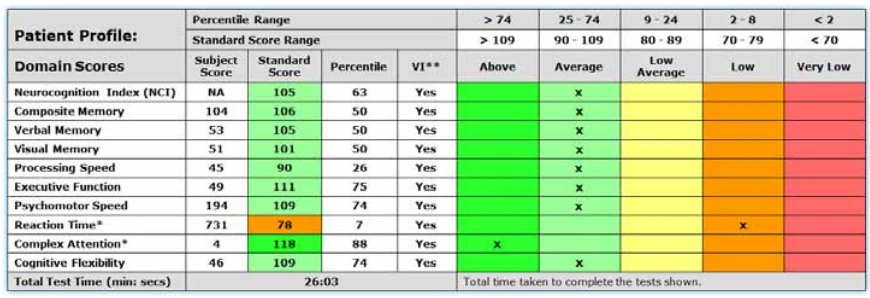
Assessment results are presented through a visual cognitive profile that highlights both strengths and areas requiring support.
Domains may include:
- Composite Memory
- Auditory Attention
- Visual Attention
- Executive Functioning
- Processing Speed
- Reaction Time
- Cognitive Efficiency
- Task Completion Speed
The visual profile makes it easier for families to understand complex assessment results and see how different cognitive skills interact.
Understanding Percentile Scores
Assessment results are often reported using percentile rankings.
Percentiles compare a child's performance with others in the same age group.
Performance Categories
- Very High: Above 98th percentile
- High: 90th–97th percentile
- Above Average: 76th–89th percentile
- Average: 40th–75th percentile
- Below Average: 25th–39th percentile
- Low: 9th–24th percentile
- Very Low: 1st–8th percentile
These scores help identify areas where additional support, intervention, or skill-building may be beneficial.
Using Assessment Results to Guide Treatment
Assessment is only the first step.
The information gathered helps create individualized recommendations that may include:
- Psychotherapy
- Play therapy
- ADHD support
- Executive functioning coaching
- Cognitive rehabilitation
- Parent coaching
- School collaboration
- Emotional regulation support
- Learning support strategies
By combining assessment findings with therapeutic expertise, support can be tailored to the child's unique profile rather than relying on a one-size-fits-all approach.
Why Families Choose Alpha Child Therapy for Child Assessments
Families across Richmond Hill and the Greater Toronto Area choose Alpha Child Therapy because assessments are designed to be child-friendly, practical, and focused on meaningful outcomes.
- Research-based assessment tools
- Technology-assisted evaluation methods
- Individualized treatment recommendations
- Child and adolescent-focused approach
- Parent consultation and feedback sessions
- Visual cognitive performance reporting
- In-person and virtual support options
Whether your child is experiencing difficulties with attention, learning, behaviour, emotional regulation, or developmental concerns, a comprehensive assessment can provide valuable insights and a clearer path forward.
Book an Assessment Consultation to learn more about the most appropriate evaluation options for your child.
Online Courses & Tools

Solutions for Sleeping Disorders
Getting a good night’s sleep is essential for both children and parents. In this episode, we discuss common sleep disturbances in children and explore the science behind sleep disorders. […]
FREE

SOS Help for Emotions: Managing Anxiety
SOS Help for Emotions – Managing Anxiety, Anger, And Depression is a self-help book that is fun to listen to and easy to apply. […]
FREE

Children's Anxiety
Anxiety in children can be subtle yet deeply disruptive—affecting their emotional development, school performance, and relationships. This comprehensive course, […]
$149.99