










How to Talk So Kids Will Listen & Listen So Kids Will Talk
May 29, 2025
After-School Restraint Collapse: Why Kids Melt Down at Home
November 18, 2026
Your teen studied for two weeks. They knew the material on Tuesday night. On Wednesday morning their mind went blank, and that pattern is what child and teen anxiety therapy treats. They could not eat breakfast that morning, and by the time the paper was in front of them the material was gone. If that pattern repeats every exam season, you are not looking at laziness or a motivation problem. You are looking at something that responds well to treatment, and the sooner you address it, the less it shapes how your teen sees their own ability.
Test Anxiety in Teens vs Ordinary Exam Nerves
Some nerves before a test are useful. They sharpen focus and push a student to prepare. Test anxiety is a form of performance anxiety, the same category as stage fright, and it works in the opposite direction. According to PrairieCare, experts estimate that up to 40 to 60 percent of students are negatively affected by it, and KidsHealth describes it as worry strong enough that a student cannot concentrate or show what they actually know. The practical line for parents is this: nerves fade once the test starts. Test anxiety gets worse once the test starts. Three questions usually separate the two. Does the worry begin days or weeks before the exam? Does your teen score well on practice work at home and far below that on the real paper? Is the fallout spilling into sleep, appetite, or school attendance? Two of those pointing the same way is worth a conversation with a child and teen anxiety therapist.
Physical Signs of Test Anxiety Parents Notice First

The body usually reports the problem before your teen does, because the fight-or-flight response does not wait for permission. What parents tend to see in the days around an exam:
-
Stomach aches and nausea, often on the morning of the test Headaches that arrive on test days and disappear on weekends Racing heart, shaking hands, or sweating before leaving the house Shortness of breath or feeling lightheaded Trouble falling asleep the night before, then exhaustion the next day UCLA Health notes that younger students in particular show up repeatedly with stomach aches that get investigated medically before anxiety is considered, because the stomach is closely tied to the fight-flight-freeze response. One detail matters here: these symptoms are real. Your teen is not inventing a stomach ache to avoid the test.
Emotional and Thinking Signs Before an Exam
The internal signs are harder to see, because teens rarely narrate them. PrairieCare lists racing thoughts, worry about failure and test day, panic, difficulty concentrating, negative self-talk, and feeling overwhelmed as the emotional and cognitive side of test anxiety. In practice, that sounds like “I am going to fail this,” “everyone else gets this except me,” or a flat refusal to discuss the exam at all. North Shore Psychological Services describes these as cognitive distortions, inaccurate thought patterns such as “I always fail tests,” and they are one of the most treatable parts of the problem. The blanking out teens describe during a test is the same mechanism. Anxious thoughts play on a loop, and the loop occupies the working memory the exam needs.
Behaviour Changes at Home During Exam Weeks

Avoiding Study, Homework and Any Talk About Tests
This is where test anxiety is most often misread as a character problem. UCLA Health puts it plainly: irritability, procrastination, and avoidance are common signs, and children who are deeply worried about their homework often cannot find a place to start, which looks like not caring when in fact they care a great deal. Some teens go the other way and over-study, refusing to stop to eat or sleep. Both directions point at the same anxiety. If avoidance has reached the point of missing classes, the pattern described in our article on school refusal in kids is worth reading alongside this one.
Sleep and Appetite Changes Around Exam Dates
Watch the calendar rather than the behaviour in isolation. Appetite drops, bedtime slips later, and sleep gets thin in the three or four days before an assessment, then normalizes afterwards. A pattern that tracks the exam schedule is anxiety. A pattern that never lifts is something broader, and our sleep problems page covers that separately.
What Drives Exam Anxiety in High School Students

Perfectionism and the Fear of Failing
KidsHealth notes that people who worry a lot or are perfectionists are more likely to experience test anxiety, as are students who care about doing well but feel unprepared. For high-achieving teens, the exam has stopped being a measure of one unit of work and has become a verdict on their intelligence, their university options and their worth. That is a heavy thing to carry into a 90-minute paper, and it is one of the main reasons confidence-building work sits alongside anxiety treatment.
Learning Disorders and ADHD Behind Exam Stress
Sometimes the anxiety is accurate. A teen who cannot process written questions at the required speed, or who loses track of a multi-step problem, has learned from experience that exams go badly. In those cases, treating the anxiety alone will not hold. An assessment for a learning disorder or for ADHD often changes both the accommodations your teen is entitled to and the story they tell themselves about their ability.
How Teen Therapy and Play-Based Methods Lower Test Anxiety
CBT for Exam Worry and Negative Self-Talk
Cognitive behavioural therapy is the main approach for test anxiety in adolescents, and it is the one with the strongest research behind it. A registered school-based trial on ClinicalTrials.gov structured CBT for test anxiety around identifying and challenging negative thoughts, relaxation, overcoming avoidance, and goal setting. In sessions with a teen, that means mapping the thought that fires before the paper is turned over, testing whether it holds, and rehearsing a replacement until it is available under pressure. It also means practical exposure work: timed practice under conditions that resemble the real exam, so the first time your teen meets that pressure is not on the day it counts.
Play and Expressive Techniques for Teens Who Will Not Talk
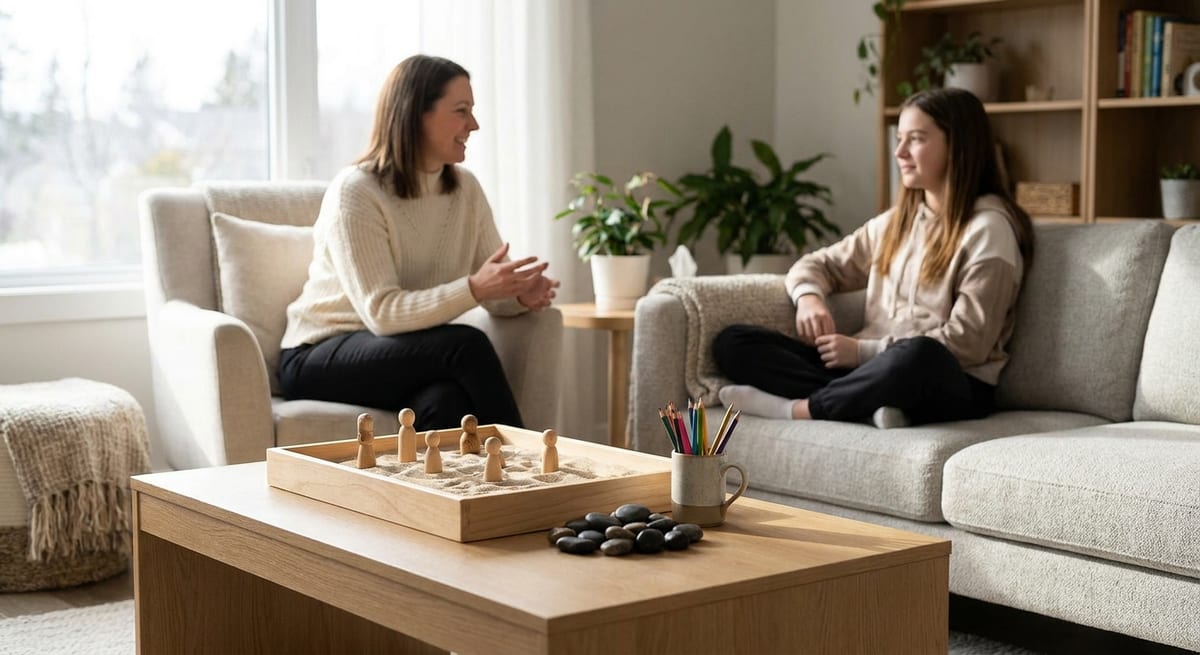
Play therapy in its classic form is designed for younger children. With teenagers, the same principle is adapted rather than applied directly, and that distinction is worth being clear about. What it looks like for an adolescent is expressive and indirect work: externalizing the anxiety as a character and arguing with it, writing the worst-case exam scenario and then rewriting it, role-playing the walk into the exam room, or using art and sand tray work to reach pressure a teen cannot yet put into sentences. This matters because many teens shut down in a face-to-face conversation about feelings. Teen therapy that gives them something to do while they talk often moves faster than one that does not.
Parent Coaching Through Exam Season
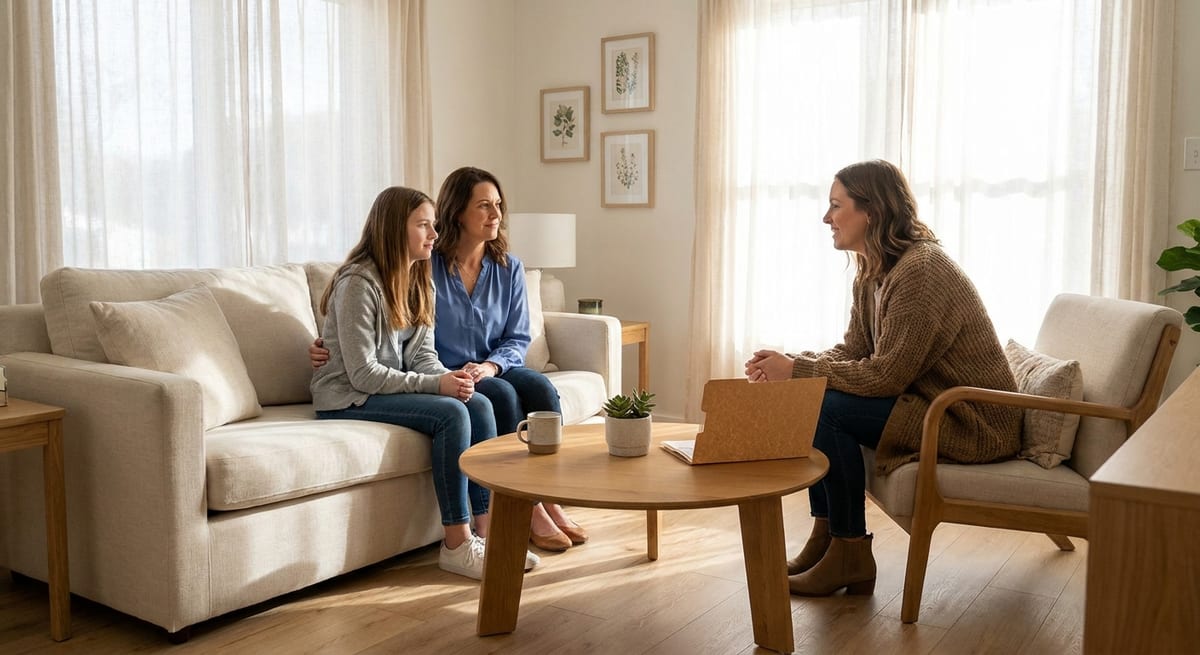
Parents are part of the treatment, not spectators to it. North Shore Psychological Services suggests normalizing anxiety as a shared human experience rather than treating it as a flaw. Parent coaching sessions work on the specific exchanges that happen in your house during exam weeks: how to ask about a test without triggering a shutdown, what to say the night before, and how to respond to a disappointing mark in a way that does not raise the stakes on the next one.
When Test Anxiety Needs a Child Anxiety Therapist
Book an assessment if any of the following is true. The anxiety is affecting sleep, appetite, or school attendance. Your teen’s marks are consistently below what they show at home. The worry has spread from exams to presentations, class participation, and social situations. Your teen is talking about themselves in absolute terms, as someone who is stupid or who always fails. Or exam season has started to look like a mental health concern rather than a school concern. North Shore Psychological Services draws the same line: when anxiety affects sleep, school attendance or mental health, therapy is a helpful next step. Exam pressure does not end after high school. The skills your teen builds now carry into university, licensing exams and job interviews, which is the strongest argument for treating this while there is time to practise. A free 15-minute consultation is enough to decide whether this needs therapy or a conversation with the school.
Frequently Asked Questions
Is test anxiety an actual diagnosis?
No. Test anxiety is not a standalone diagnosis in the DSM-5. It is understood as a form of performance anxiety and is often treated as part of a broader anxiety picture. The absence of a diagnostic label does not mean it is untreatable, and CBT research for test anxiety in adolescents exists independently of that question.
At what age does test anxiety usually start?
It can appear well before high school. UCLA Health notes that academic anxiety affects younger students as much as it affects high school and college students, and in younger children it tends to show up as physical complaints rather than as stated worry about the test.
Can test anxiety make a teen skip school?
Yes. Avoiding studying and skipping school are both documented responses, and avoidance is one of the mechanisms that makes test anxiety worse over time, because each avoided test confirms that the fear was justified. Repeated absence around assessment days is worth taking seriously rather than treating as a discipline issue.
How long does therapy for test anxiety take?
It varies with how long the pattern has been in place and whether anything else is driving it. The CBT protocols used in adolescent test anxiety research typically run around six weekly sessions, sometimes with booster sessions afterwards. Where a learning disorder or ADHD is also present, the timeline depends on the assessment and the accommodations that follow.
Does play therapy work for teenagers?
Not in the form used with young children. What works with teenagers is the adapted version: expressive, creative, and role-play techniques used inside teen therapy, usually alongside CBT. If your teen is 15 and you have been told they need play therapy, ask specifically how it will be adapted for their age.